
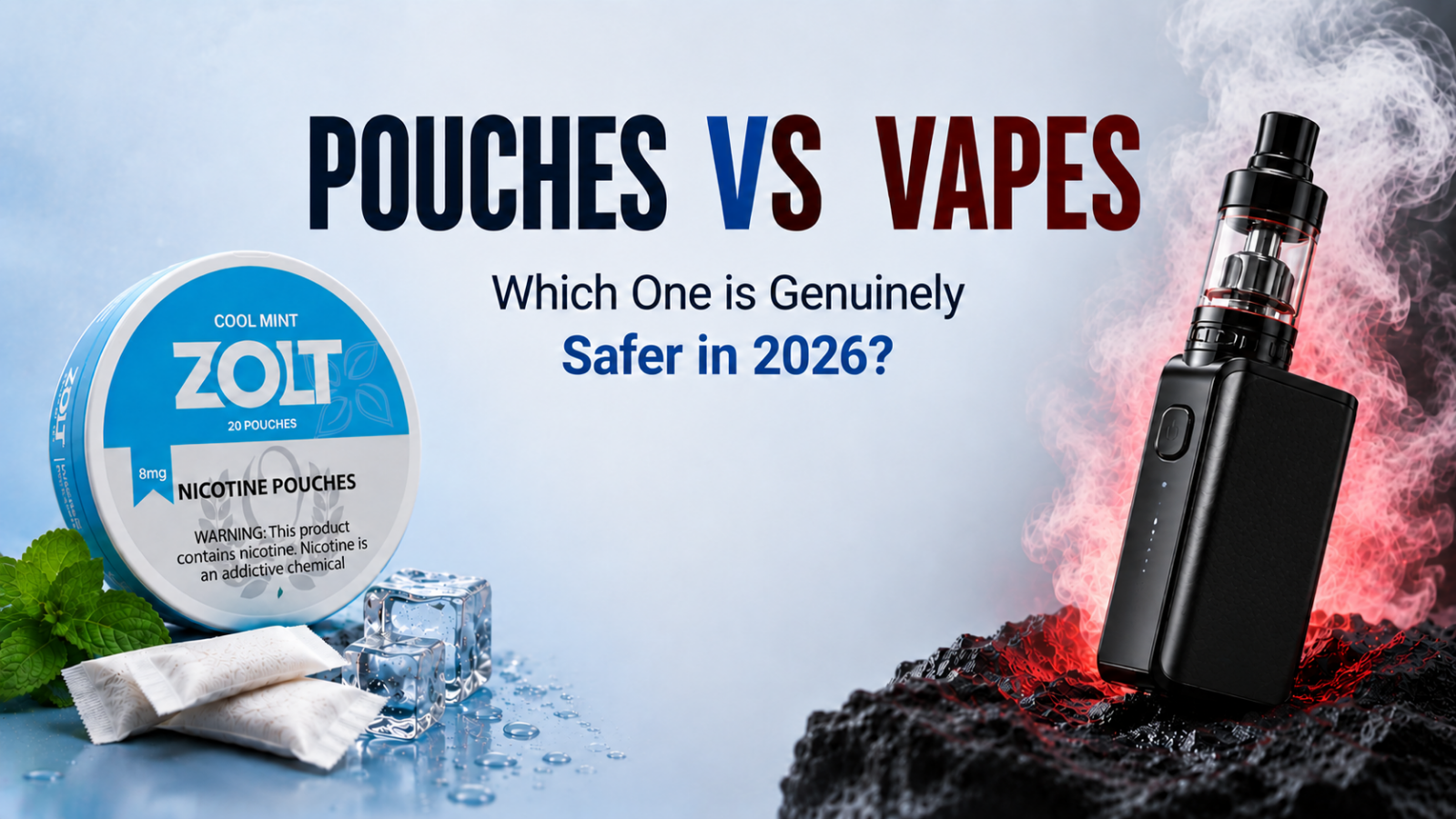
If you’ve been thinking about switching away from cigarettes, chances are you’ve already come across two popular options, vapes and strong nicotine pouches. Both are marketed as alternatives to smoking, and both have grown massively in popularity over the last few years. But which one is actually safer? And more importantly, which one makes more sense for you in 2026?
Let’s break it all down in plain, simple terms, no medical jargon, no scare tactics, just honest information.
What are Nicotine Pouches, Exactly?
Nicotine pouches are small, white pouches that you place between your upper lip and gum. They don’t contain any tobacco leaf, which is why they’re often called tobaccoless pouches. You don’t smoke them, you don’t heat them, and you don’t swallow them. The nicotine is absorbed through the lining of your mouth over a period of around 20 to 60 minutes, depending on the strength you choose.
Strong nicotine pouches, in particular, have become one of the most searched products in this category. Brands like ZYN, VELO, and On! offer pouches in varying strengths, from as low as 3mg all the way up to 11mg or more per pouch. For people who were heavy smokers, the stronger options tend to satisfy cravings more effectively. If you’re looking for the best tobacco-free pouches, it mostly comes down to the nicotine strength, the flavor, and how well the pouch sits comfortably under your lip.
What Are Vapes?
Vapes, also called e-cigarettes or electronic nicotine delivery systems (ENDS), work by heating a liquid (called e-liquid or vape juice) into an aerosol that you inhale. The liquid usually contains nicotine, flavorings, propylene glycol, and vegetable glycerin. Unlike traditional cigarettes, there’s no combustion involved, which means no actual smoke.
Vaping exploded in popularity around 2012-2015 and has stayed popular ever since. By 2026, vaping will be regulated much more strictly in most countries, including the United States, where the FDA has tightened its grip on which products can be legally sold. Despite this, vapes remain widely available and widely used.
The Safety Question: Let’s Be Honest
Neither vapes nor nicotine pouches are 100% safe. Any product that contains nicotine carries health risks. Nicotine is addictive, it raises blood pressure, and it isn’t recommended for pregnant women or people with heart conditions. That’s just the truth, and it’s important to be upfront about it.
That said, when we compare these two products against each other, and especially against cigarettes, the differences are pretty significant.
Vaping eliminates the toxic combustion byproducts found in cigarette smoke, which is a real advantage. However, research published through 2025 and early 2026 continues to raise concerns about the effects of inhaling heated aerosols over a long period. The lungs are sensitive organs, and while vaping is widely considered less harmful than smoking, it still involves your respiratory system in a way that carries risk. There have also been ongoing concerns about certain flavoring chemicals and their long-term effects on lung tissue.
Strong nicotine pouches, on the other hand, don’t involve the lungs at all. Since you’re not inhaling anything, there’s no respiratory exposure. The risk is more localized to the oral cavity; long-term use of any oral nicotine product can cause gum irritation, and in rarer cases, there are concerns about oral tissue effects with heavy use. But current evidence strongly suggests that tobaccoless pouches are significantly lower risk than both smoking and vaping, primarily because nothing is being inhaled.
Public Health England (now the UK Health Security Agency) and other health bodies have consistently indicated that smoke-free and vapor-free nicotine products sit at the lower end of the risk spectrum. In 2025, the FDA also began approving certain nicotine pouch products under its modified risk tobacco product (MRTP) pathway, a significant regulatory milestone that signals growing confidence in their relative safety profile compared to combustible products.
Convenience and Discretion: Pouches Win Here
Let’s talk about day-to-day practicality, because safety isn’t the only thing that matters when choosing a product you’ll actually stick with.
Vapes require charging, refilling, or replacing pods, and they produce visible vapor, which can be a problem in offices, restaurants, or around kids. They’ve also faced bans in many indoor spaces. If you forget to charge your vape or run out of pods, you’re stuck.
The best tobacco free pouches, by contrast, are incredibly simple. You open a can, take one out, and pop it under your lip. No charging, no vapor, no smell that lingers on your clothes or breath (or at least, much less so). You can use them at your desk, on a plane, in a movie theater, basically anywhere. Strong nicotine pouches are also easy to dose, since each pouch has a clearly labeled milligram strength, so you know exactly what you’re getting.
Cost Comparison in 2026
Vaping costs vary a lot depending on whether you’re using a disposable, a refillable pod system, or a more advanced mod setup. Disposable vapes, which remain popular despite increased taxes in 2026, can run anywhere from $8 to $20 per unit, and heavy users might go through one every few days. That adds up fast.
A can of nicotine pouches typically contains 15 to 20 pouches and costs between $5 and $8 in the US market. If you’re using two to four pouches a day, a can lasts you several days. Over a month, the cost tends to be comparable or slightly lower than vaping, though this varies by usage and brand.
Who Should Consider Switching to Pouches?
If you’re someone who has tried vaping and found it didn’t quite scratch the itch, or if you’re concerned about what inhaling anything does to your lungs, tobaccoless pouches might be worth trying. They’re also a strong choice if you need something discreet for work or travel.
Strong nicotine pouches work particularly well for former heavy smokers who need a higher nicotine hit to manage cravings. The 8mg and 11mg options available from many brands provide a satisfying experience without the need to step outside or pull out a device.
That said, if you’re currently not using any nicotine product, starting pouches or vapes isn’t recommended. The goal for most people is to reduce dependence on nicotine over time, not to start it.
What Experts Are Saying in 2026
The conversation around nicotine alternatives has matured a lot. Harm reduction, the idea that if someone is going to use nicotine anyway, they should use it in the least harmful form, is now mainstream in public health discussions. Organizations like the American Cancer Society acknowledge that while quitting nicotine entirely is the ideal outcome, switching from cigarettes to lower-risk products is a meaningful step.
The growing body of research on tobaccoless pouches is largely reassuring, especially when compared to inhaled products. The best tobacco free pouches avoid the combustion-related carcinogens entirely and deliver nicotine in a way that keeps the respiratory system out of the equation. That’s not a small thing; lung disease and respiratory cancers are among the most serious consequences of long-term smoking and, potentially, long-term vaping.
The Bottom Line
If you’re comparing strong nicotine pouches to vapes purely on a safety basis, the current weight of evidence leans toward pouches being the lower-risk option, mainly because there’s no inhalation involved. Vapes are a step down from cigarettes, but they still carry unknowns around long-term respiratory health. Tobaccoless pouches sidestep that entire category of risk.
Neither product is harmless, and nicotine addiction is a real concern regardless of the delivery method. But for adults who are already using nicotine and looking for a less harmful way to do it, the best tobacco free pouches represent a practical and increasingly well-supported choice.
If you’re curious about trying strong nicotine pouches, explore what’s available at Zolt USA, a range built for people who want real nicotine satisfaction without the tobacco, the smoke, or the vapor.
Frequently Asked Questions (FAQs)
Are strong nicotine pouches safer than vaping?
Based on current research, strong nicotine pouches are generally considered lower risk than vaping because they don’t involve inhaling anything into the lungs. However, no nicotine product is completely risk-free, and both should be used with caution.
What are tobaccoless pouches made of?
Tobaccoless pouches are made from a plant-based fiber material, nicotine (usually derived from the tobacco plant but not the leaf itself), flavorings, and stabilizers. They contain no tobacco leaf, no tar, and no combustion byproducts.
How do I choose the best tobacco free pouches for me?
It depends on your current nicotine usage. If you were a heavy smoker or are used to a strong vape, starting with a higher-strength pouch (6mg-11mg) often works better for managing cravings. If you’re a lighter user, lower strengths (3mg-4mg) might be enough. Flavor and fit under the lip also play a big role in what feels comfortable.
Can I use nicotine pouches indoors or at work?
Yes, one of the biggest advantages of tobaccoless pouches is that they produce no vapor, no smoke, and very little odor. Most workplaces and public indoor spaces don’t restrict them the way they do vaping or smoking. Always double-check your specific workplace policy to be sure.
Are nicotine pouches approved by the FDA?
Some nicotine pouch products have been reviewed and authorized by the FDA under its premarket tobacco product application (PMTA) process, and certain products have been granted modified risk designations. Regulations continue to evolve in 2026, so it’s worth checking whether the specific brand you’re considering has received FDA authorization.

No responses yet